

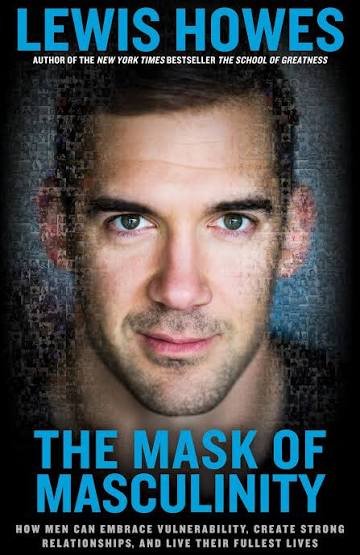
The Mask of Masculinity
A Reflection on The Mask of Masculinity by Lewis Howes
I want to start by saying that I liked this book. I have criticisms of it, and there are places where I wish Lewis Howes had gone considerably further, but I think The Mask of Masculinity could be genuinely helpful for men trying to understand why they aren't as happy, connected, or fulfilled as maybe they expected to be in their pursuits.
Howes organizes the book around nine "masks" men can learn to wear. I don't think the real value is in deciding which kind of man you are, or even identifying which mask fits you best. Most men will probably recognize themselves in several of them, at different times and in different circumstances. Howes himself identifies himself with all of them, at some point or another in his life. I too could see myself in several of the masks. What I think men might find useful here is the way the masks give us language for recognizing the different ways masculinity can become a performance.
“[...] there is nothing scarier than a man who can’t admit that he doesn’t know what he’s doing.”
Men receive an enormous number of messages about what we're supposed to be. We're supposed to be strong, capable, successful, confident, sexually desirable, knowledgeable, funny, resilient, independent, and in control. Some of those qualities can be perfectly healthy, and some may genuinely be important parts of how we experience our masculinity. The problem is what happens when they become requirements, and when we start believing that our value as men depends on continually demonstrating them. This leads to what we call “performative masculinity” - the idea that we, as men, continually have to perform and prove ourselves to be masculine.
I think that's one of the things Howes gets right. These masks are performative, but what he also points out is that they're also protective. Boys learn very early which behaviours earn approval and which ones invite shame. We learn what other boys respect, what our parents celebrate, what we're told women want from us, and which parts of ourselves we're expected to hide because they're weak, feminine, gay, embarrassing, or simply "not what men do." If we believe we're only going to be respected and valued when we successfully perform one of these roles, the performance becomes a way of protecting ourselves from rejection.
“The research shows that the embrace of traditional masculinity increases the possibility of domestic violence and abuse committed by a man. If you’re told all your life to “man up,” and you’re not taught any of the other things a man ought to do, then is it any wonder that you’d grow up thinking that a fist is the solution to everything? If you’re told that your physical dominance over a woman is what makes you a man, how else would you act?”
I can certainly recognize that process in my own life. I wasn't a particularly skilled athlete growing up, but when hockey became more physical and my size became an asset in football and rugby, I discovered that toughness was something I could be good at. My nickname in high school football was "the Beast," and some of the stories my Dad still tells most proudly are about how tough a player I became. It felt good to discover something that earned that kind of recognition. Being tough and invincible, both on and off the field, was a way of finding approval and acceptance, in both my family and in my peer groups.
That's part of what makes these masks so complicated. They aren't simply bad behaviours men need to stop doing. They often work, at least for a while. Being tough can earn respect. Knowing things can make us feel valuable. Humour can create connection and get us through uncomfortable moments. Stoicism can help us function when things are difficult. Working relentlessly can produce real success. The problem is when these things stop being qualities or tools we can choose and become identities we have to maintain.
At that point, the mask starts costing us something. We can become so invested in appearing strong that we can't ask for help, so invested in being right that we lose our curiosity, or so focused on achievement that we neglect the relationships the achievement was supposedly meant to support. We can become very good at performing a version of masculinity that doesn't actually make us feel particularly good about being men.
That's where The Mask of Masculinity connects with how I've been thinking about grounded masculinity. I don't think masculinity should be something we have to continually prove. It should be something stable enough that we can decide what kind of men we want to be without constantly checking whether we're measuring up to somebody else's definition.
A lot of popular conversations about masculinity seem determined to establish the correct version. Men should be dominant, wealthy, muscular, sexually successful, stoic, dangerous, protective, providers, leaders, or some constantly changing combination of these things. The goalposts keep moving because the performance can never really be completed. Masculinity starts to operate like Highlander: there can be only one, and somebody always has to prove he's more masculine than somebody else.
This is where I struggled with parts of Howes' discussion of the Alpha Mask. I think he does a good job identifying the problems created when men organize their identities around dominance, but I don't think he goes far enough in challenging the premise underneath the idea of being "alpha." In particular, his discussion of men as leaders within the family seems to preserve some of the hierarchy he's otherwise asking us to examine.
Why does a man need to be the leader of his family? What does that idea mean in a relationship between two men? What happens when a woman is a more capable leader in a particular area of a heterosexual relationship? Leadership, confidence, assertiveness, resilience, and strength can all be meaningful qualities, and they can absolutely be connected to someone's experience of masculinity. But none of them require a hierarchy in which being masculine means someone else has to follow.
I also think this part of the book feels different now because the cultural conversation around masculinity has changed considerably. There is an enormous online ecosystem offering men increasingly rigid answers about what a "real man" is supposed to be. At its most extreme, it becomes almost cartoonish: be wealthy, sexually dominant, physically imposing, emotionally untouchable, unquestionably knowledgeable, aggressive, and perpetually in control. What interests me isn't simply how absurd that performance can become, but why it remains appealing. If these masks protect us from shame and uncertainty, then someone offering absolute certainty about how to become a man can be very compelling to someone who doesn't feel secure in being one.
Howes' answer to much of this is vulnerability, connection, reflection, and curiosity, and I think he's right. Where I wanted more from the book was in explaining how men actually get there. Vulnerability isn't simply deciding to open up. For someone who has spent decades learning to avoid vulnerability, he may not even recognize what he's feeling well enough to talk about it. Emotional literacy is a skill, and many men have had very little opportunity to develop it.
“If you think about it, men who come of age without being nurtured and without learning how to nurture themselves have a hole they carry around. Some people fill this hole with drugs or alcohol; others fill it with violence. But it gets filled, one way or another.”
This is probably my biggest criticism of the book's structure. Howes ends the chapters with questions and exercises intended to help men begin taking off these masks. They're decent entrances into self-reflection, but they feel brief compared with the complexity of what he's showing us as the problem, and then asking us to change. At times, the structure can make it seem as though recognizing a mask, answering a few questions, and trying an exercise is enough to shed something that may have been protecting you for most of your life. It won’t.
There are no silver bullets for this kind of work. Recognizing the mask is step one. Learning to notice when it comes back, becoming curious about what it's protecting, and finding another way to respond takes considerably more work. For many men, I think that means therapy and developing greater emotional literacy, but it also means building healthier relationships with women and other men, learning how to balance self-criticism with self-gratitude, and becoming skeptical of anyone selling a one-size-fits-all solution to what a man is supposed to be. Even as a therapist, I feel like I still have a lot to learn about these mechanisms, and how to reach men that are so shut off. I’m still learning, so even those things aren’t a complete path to freedom from these masks.
“Masculinity is about discovering yourself and owning what you find. It’s about being kind to others, and pursuing your dreams with all the passion and energy you can muster. It’s about doing something that is meaningful to you that brings value to others. That’s how you build a legacy.”
I would have liked Howes to devote more of the book to that process. He could have worked with psychologists or other mental health professionals to create more robust exercises throughout the book, or devoted several chapters toward what actually happens after we recognize ourselves in these masks. I also think the conclusion could have done more to revisit the masks collectively and explore what we might build in their place. That might be an unfair criticism of the book, because what it does well is identify what is on the cover - the Masks.
“Masculinity is not about being the biggest, the fastest, the strongest, the one who sleeps with the most girls, and the one who has the most money. The one who has the most accomplishments is not the most masculine. In fact, it is often the men who covet these things most who are covering and compensating for the greatest insecurities. Let us revere the one who loves others deeply, loves himself deeply, and has a dream that he is inspired to live with and by and through. He is a man.”
I do think Howes tries a bit to define what masculinity isn’t, and then does try to establish what makes a good man. While I don’t disagree with some of his conclusions, I don't think the answer is another definition of masculinity. In fact, I think replacing Howes' nine masks with a new checklist for being a "good man" recreates the same problem. There is no singular definition of masculinity. It has changed across history and cultures, and we're now living at a time when we have access to an extraordinary range of human experience, research, and perspectives that allow us to question some of the assumptions previous generations simply inherited.
Maybe the more useful question is what being a man means to each of us once we begin stripping away some of those inherited expectations. Which qualities actually reflect our values, and which ones are performances designed to earn approval? What parts of ourselves have we rejected because somebody taught us they weren't masculine enough? What kind of relationships do we want with other men, with women, with our partners, with our children, and with ourselves?
“The less a person understands his own feelings, the more he will fall prey to them. The less a person understands the feelings, the responses, and the behavior of others, the more likely he will interact inappropriately with them and therefore fail to secure his proper place in the world.”
That's where I think grounded masculinity begins. Not with another definition we're all expected to follow, but with a masculine identity stable enough that it doesn't require constant proof. We can be strong without needing someone else to be weak, confident without needing to dominate, knowledgeable without needing to know everything, and vulnerable without surrendering our masculinity. The point isn't to discard qualities traditionally associated with masculinity, but to examine whether we actually value them or whether we're using them to convince ourselves and everyone else that we measure up.
I think The Mask of Masculinity provides a very good starting point for that examination. It isn't the only book I'd want men to read about masculinity, and I don't think it takes the reader as far into the inner work as it could have. What it does particularly well is give men a way to recognize themselves. For a man who is successful but dissatisfied, struggling in his relationships, uncomfortable with vulnerability, or simply beginning to question what he's been taught about being a man, seeing the mask may be enough to start asking better questions.
I would happily include this in a broader curriculum for men who want to become healthier, happier, more connected versions of themselves. Not because Howes has figured out what the "right" kind of masculinity looks like, but because he gives us a useful place to begin examining how much of what we've been calling masculinity was something we learned to perform in the first place.
Special Order at Cedar Canoe Books
If you'd like to support a wonderful independent bookstore, you can Special Order this book through Cedar Canoe Books clicking on the image of the book cover.
BEARMIND NOTES
Worth Reading?
Yes, with caveats.
Who I Recommend It To
Men who are unhappy, dissatisfied, struggling in their relationships, or beginning to question what they’ve been taught about masculinity. It’s particularly useful for men trying to recognize the ways they may be performing masculinity in search of validation, belonging, success, or a sense that they’re finally “man enough.”
The Caveats
This is a starting point, not a roadmap. Howes does a good job helping men recognize the masks they may be wearing, but the exercises don’t go deeply enough into the emotional work required to take them off.