

Adult Children of Emotionally Immature Parents
A Reflection on Adult Children of Emotionally Immature Parents by Lindsay C. Gibson
The biggest strength of Lindsay Gibson’s Adult Children of Emotionally Immature Parents is that it manages to explain complicated psychological processes in language that is clear, relatable, and immediately recognizable. It gives readers a way to contextualize and name what it felt like to grow up with parents who were emotionally unavailable, volatile, self-involved, inconsistent, or simply unable to meet their children in the places they most needed connection. I think that clarity is both the book’s greatest strength and, occasionally, one of its limitations.
“If parents don’t label their own behavior as abusive, their child won’t label it that way either. Even as adults, many people have no idea that what happened to them in childhood was abusive. As a result, they may not recognize abusive behavior in their adult relationships.”
Even after reading this book, as much as I love it, I don’t particularly love the term “emotionally immature,” even though I think it describes something real. From a clinical developmental perspective, the term immaturity makes sense. Immaturity in itself is a neutral term that describes a stage of growth. Some people reach adulthood without developing much emotional literacy, emotional flexibility, or comfort with vulnerability. They may be perfectly capable in other areas of their lives while remaining remarkably limited when emotional connection, self-reflection, accountability, or intimacy are required. In ordinary language, though, calling someone immature can sound like an insult, and the term can quickly become another label we use to dismiss someone rather than understand them.
I find myself thinking about emotional literacy instead. Some people were never taught how to read the emotional world, including their own. They never developed the language for it, and they may have spent a lifetime learning to avoid it. That framing leaves open an important question, though: can everyone learn?
This was probably the part of the book I found most personally and professionally difficult. Gibson spends a great deal of time helping adult children recognize that they may never receive the emotional relationship they have been trying to create with their parents. No amount of explaining, accommodating, empathizing, performing, or finally finding the right words can make another person become emotionally available. There is a lot of value in her message that healing may require us to stop investing so much energy in trying to change another person and begin redirecting that energy toward ourselves.
As a therapist, I understand the principle. We cannot change another person. We can change how we respond, what we tolerate, what we ask for, and how much access someone has to us, but we cannot manufacture another person’s willingness to look inward.
As a son, I find that considerably harder to accept. There is still a part of me that wants to believe that if people can understand why they behave the way they do, they can change. Gibson might call that its own version of the “healing fantasy,” the hope that eventually something will happen, something will finally be understood, and the relationship we have spent years reaching for will become possible.
I think that is one of the most difficult ideas in the book. Sometimes it may not become possible, and accepting that can be both freeing and deeply sad.
That doesn’t mean emotionally immature parents are monsters, nor do I think Gibson really portrays them that way. Emotionally immature parents make sense too. Many were raised in homes that were abusive, neglectful, emotionally barren, or far more rigid than the homes they later created themselves. They often inherited exactly the lack of emotional tools they now struggle to provide. Understanding that history can create compassion, but compassion does not necessarily create capacity. We can understand why someone became emotionally limited without pretending their limitations didn’t hurt us, and we can recognize their wounds without continuing to organize our lives around the hope that we can heal those wounds for them.
Gibson’s distinction between internalizers and externalizers is useful, although this is another place where I would have preferred to see processes described rather than people categorized. She acknowledges that these tendencies exist on a spectrum and that most of us will use some of each, but I generally struggle with frameworks that begin to sound like there are “two kinds of people in the world”. I would rather think about internalizing and externalizing as different strategies we might use to manage emotional distress.
One child might learn to turn inward, manage everyone else’s emotions, take too much responsibility, disappear into pleasing, competence, or self-criticism. Another might push distress outward, depend heavily on other people for regulation, blame, react, or demand that the environment change around them. There are countless variations within both processes, and popular psychology now seems to generate new names for them constantly. The labels matter less to me than understanding what the behaviour was trying to accomplish and why it developed in the first place.
“No child can be good enough to evoke love from a highly self-involved parent. Nevertheless, these children come to believe that the price of making a connection is to put other people first and treat them as more important. They think they can keep relationships by being the giver. Children who try to be good enough to win their parents’ love have no way of knowing that unconditional love cannot be bought with conditional behavior.”
The four types of emotionally immature parents Gibson proposes are recognizable and useful, particularly for readers trying to put words to experiences they may never have understood before. At the same time, there is considerable overlap between the checklists. I found myself wishing Gibson had separated the common characteristics into a fifth list of traits shared across emotionally immature parenting and then used the four categories primarily to distinguish the ways those patterns can present. Still, I understand why the categories work. Sometimes we need something concrete to anchor ourselves to before we can begin appreciating the nuance.
What I think the book gets unmistakably right is its recognition that emotionally immature parenting is a form of emotional neglect and is developmentally damaging. Children need more than food, shelter, discipline, education, and physical safety. They need emotional responsiveness. They need adults who can tolerate their feelings, remain curious about their internal experiences, repair ruptures, and help them learn what emotions mean.
When those experiences are consistently absent, children adapt. Gibson suggests many become extraordinarily attentive to the emotional states of everyone around them while knowing remarkably little about their own. They may learn that having needs creates conflict, that vulnerability is dangerous, or that connection depends on being useful, agreeable, invisible, impressive, or easy to manage. Those strategies often follow us into adulthood because, at one point, they worked.
“Emotional intimacy involves knowing that you have someone you can tell anything to, someone to go to with all your feelings, about anything and everything. You feel completely safe opening up to the other person, whether in the form of words, through an exchange of looks, or by just being together quietly in a state of connection. Emotional intimacy is profoundly fulfilling, creating a sense of being seen for who you really are. It can only exist when the other person seeks to know you, not judge you.”
Reading this book also left me wondering about the larger cultural picture. In my work, and increasingly in the conversations I see happening around mental health, I encounter an enormous number of adults who seem to be learning emotional literacy for the first time. Many describe childhood homes that were emotionally barren, unpredictable, volatile, or simply uncomfortable with feelings. I’m cautious about drawing a broad cultural conclusion from what I see as a therapist, because there is an obvious selection bias in who arrives in a therapy office. Still, it leaves me wondering whether we are seeing the effects of generations in which emotional development received far less attention than it does now, and what that might mean for our increasing sense of relational disconnection.
One area I wish the book explored more deeply is what happens in the next generation. Gibson is primarily interested in helping adult children understand what happened to them, and that focus makes sense. But I kept wondering what determines whether someone raised by emotionally immature parents grows into an emotionally reflective adult or repeats some of the patterns they were shown. Does becoming a parent activate unresolved patterns from our own childhood? Are certain coping strategies more likely to reproduce emotional immaturity? Can emotional literacy be learned later in life by someone who has spent decades avoiding self-reflection, and if so, what makes that possible?
I don’t know the answers to those questions, and this book doesn’t really attempt to answer them. That isn’t necessarily a failure of the book, because it isn’t the book Gibson set out to write. It did leave me wanting to understand that developmental pipeline better, particularly because the possibility of interrupting intergenerational patterns is so important to the work many of us are trying to do.
Despite those criticisms, I think Adult Children of Emotionally Immature Parents is an extremely valuable book. It gives people accessible language for experiences that are often difficult to describe, and more importantly, it redirects the question away from “How do I finally get my parent to understand me?” toward understanding what we actually have control over.
What someone does with that realization is deeply personal. It might involve grieving the relationship they hoped to have, changing expectations, creating boundaries, finding a different way to remain connected, creating distance, or sometimes ending a relationship altogether. The important part is recognizing that there may be nothing an adult child can do to finally elicit the emotional connection they have spent years searching for. Understanding our parents can be part of healing, but our healing cannot remain dependent on their willingness to understand themselves.
“Remember, you can’t expect immature, emotionally phobic people to be different from how they are.”
That may be the part of Gibson’s book I find hardest to accept, and perhaps the part I most needed to read.
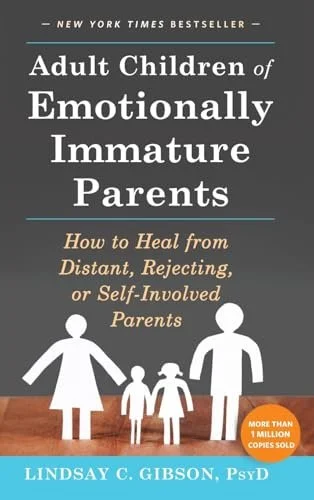
Special Order at Cedar Canoe Books
If you'd like to support a wonderful independent bookstore, you can Special Order this book through Cedar Canoe Books clicking on the image of the book cover.
BearMind Notes
Worth Reading?
Absolutely.
Who I Recommend It To
Anyone exploring how their childhood relationships continue to shape their adult life, particularly those who grew up with emotional neglect, volatility, inconsistency, or parents who struggled with emotional connection. I think it should also be required reading for therapists, and would recommend it to emotionally reflective parents interested in understanding the patterns they inherited.
A Note of Caution
The categories in this book are useful because they give us language for patterns that can otherwise be difficult to recognize. They can also become labels we use to diagnose, dismiss, or villainize other people. I think this book is most valuable when we use it to better understand ourselves and our relationships, rather than as evidence that someone else is the problem.