

Ishmael
A Reflection on Ishmael by Daniel Quinn.
Every culture tells stories about itself. Every person tells stories about themselves, about others, and about the world. That might describe Narrative Therapy in a nutshell.
We tell ourselves stories about success, progress, human nature, and what it means to live a good life. Most of us inherit those stories without ever realizing they're stories at all. Sometimes, we mistake them for reality. That's the premise at the heart of Ishmael. Are our stories real, or are they something else?
Daniel Quinn's novel isn't really about a gorilla teaching philosophy. It's about examining the stories we've inherited and asking whether they're still serving us. It invites us to step outside our assumptions about humanity's place in the world and look at them with fresh eyes. That's a difficult thing to do, and it's one of the reasons this book has remained with me since I read it almost 30 years ago, and why I’ve read it again and again.
One of the ideas I found most compelling is Quinn's treatment of mythology. We often dismiss ancient stories because they aren't historically accurate. In other cases, we treat them as absolute truth despite having only tenuous ties to the historical record. Either way, we miss something important.
Quinn offers a middle ground. It's not an entirely new idea, but it was one presented in a way that made sense to me at the time. What if these stories were never meant to preserve facts? What if they were preserving wisdom?
Before writing, cultures passed knowledge from one generation to the next through stories. Metaphor carried ideas that facts alone never could. Somewhere along the way, I think we became so concerned with whether those stories were literally true that we stopped asking what they were trying to teach us.
That idea feels just as relevant in therapy. Much of therapy involves exploring the stories we've come to believe about ourselves. Stories about our worth, our relationships, our failures, and what kind of life we're capable of living. Some of those stories help us. Others keep us trapped. Growth often begins when we realize that the story we've inherited isn't the only one available to us. Ishmael asks us to do the same thing as a society.
“The premise of the Taker story is ‘the world belongs to man’. … The premise of the Leaver story is ‘man belongs to the world’.”
The book's distinction between "Leavers" and "Takers" is probably its best-known idea. Like any framework, it's an oversimplification. Human history is far more complicated than two categories, and Quinn smooths over plenty of that complexity.
But I've come to think that the framework isn't really about cultures. It's about values. One mindset asks, "How much more can I have?" The other asks, "How much is enough?" That's a simplification too, but it's a useful one because it shifts the conversation away from technology or agriculture and toward stewardship.
I don't think Quinn is asking us to abandon modern life or romanticize pre-agricultural societies. Indigenous cultures, like every culture, had their own strengths and shortcomings. What I think he is asking is whether we've forgotten something important along the way. We've forgotten that we're participants in the world, not owners of it.
We're connected to each other, to the environment, to the generations that came before us, and to the generations that will come after. When we begin to see ourselves as separate from those relationships, we don't just damage the world around us. We lose something of ourselves.
That's why I think the ideas in Ishmael have aged so well.
Today, we're surrounded by competing stories about what makes a successful life, what progress looks like, and what we owe one another. We often assume those stories are simply reality, when in fact they're interpretations of reality. Two people can look at the same world and arrive at completely different conclusions because they're living inside different narratives.
“We’re not destroying the world because we’re clumsy. We’re destroying the world because we are, in a very literal and deliberate way, at war with it.”
I’d like to think Quinn isn’t asking us to reject modern society. He asks us to examine the story it's built upon. I don't agree with every conclusion he reaches, and I think some of his arguments are necessarily simplified to make a broader philosophical point. But that doesn't diminish the value of the questions he asks. In many ways, the questions are more important than the answers.
For me, Ishmael isn't ultimately a book about environmentalism. It's a book about connection. It's a reminder that wellbeing isn't just about the individual. It's about our relationship with ourselves, with one another, with the natural world, and with the future we're helping to create.
I don't think the answer is that we should return to an earlier way of living. I think the answer is that we should recover some of the values we've left behind. Stewardship instead of ownership. Enough instead of more. Belonging instead of separation.
Those ideas have become part of how I think about psychology, community, and what it means to live a meaningful life. Whether Quinn is entirely right almost feels beside the point. The value of Ishmael isn't that it gives us better answers. It's that it teaches us to ask better questions, and to reconsider whether the story we're living is still the one we want to tell.
“The obvious can sometimes be illuminating when perceived in an unhabitual way.”
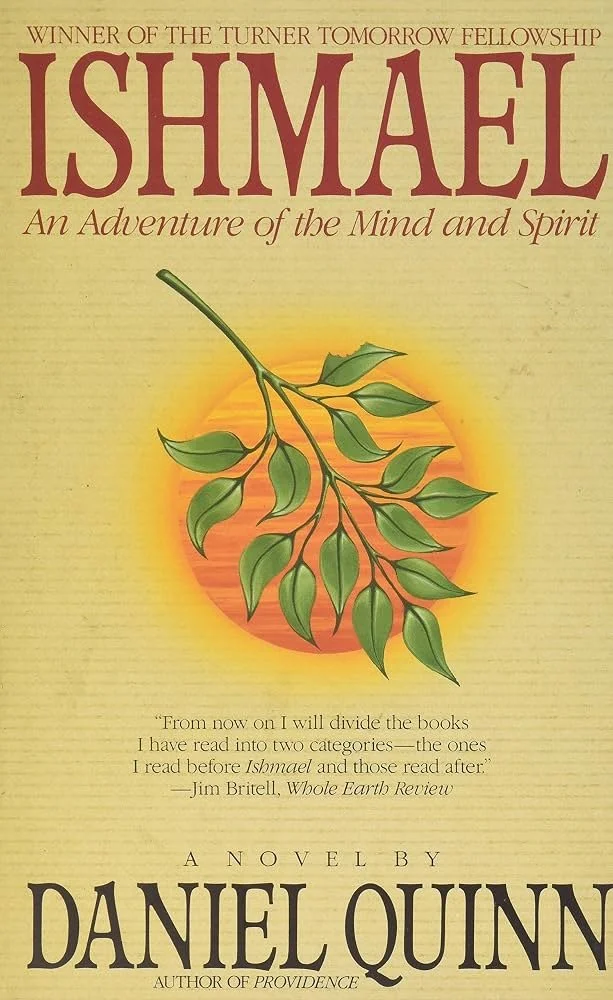
Special Order at Cedar Canoe Books
If you'd like to support a wonderful independent bookstore, you can Special Order this book through Cedar Canoe Books clicking on the image of the book cover.
BEARMIND NOTES
Worth Reading?
I’d like to think so.
Who I Recommend This To
Anyone interested in psychology, philosophy, environmental stewardship, mythology, or simply questioning the stories we inherit about what it means to be human.
“There is no one right way to live.”
“The journey itself is going to change you, so you don’t have to worry about memorizing the route we took to accomplish that change.”